Thursday, February 9, 2017
Homework Control
Humans control their own destiny as they have been placed as the top of the food chain for all of Earth. As we progress and advance technology we continue to assert our dominance over all species. We can control our future as we can make sure history doesn't repeat itself, but lust and power hang heavy over the heads of many. As technology continues to upgrade, the lust for the power becomes easier to obtain by many. we can control it, but only if the people choose to make the hard decisions to keep our societies in check.

Tuesday, February 7, 2017
Progressivism
1) Flying Taxi's, Moon Travel Frequently, Flying machines to catch birds, Firefighters with batwings, blimp boats, domesticate whales and use for transportation, Robots. These were all suggestions a theories of how the people in the early 20th century viewed how we would live today.
http://www.upworthy.com/11-ridiculous-future-predictions-from-the-1900-worlds-fair-and-3-that-came-true
https://www.wired.com/2014/05/victorian-postcards-predict-future/
http://weburbanist.com/2013/05/08/future-past-7-wonders-predicted-100-years-ago/
2) Most all of these are unrealistic and sort of a wish list for the people. During the time of fast developing technology, many people had a a broad creativity in their mind.
3) Some variations have happened, but many on a lesser and more intelligent scale. Planes are not flapping wings, but we have not made flying cars yet. We have gone to the moon, but it is not like taking a subway to New York City.
4) Most of these predictions revolve around transportation and technology. As the industrial age has made many leaps in technology the morale of creating new items is up.
5) I see warfare advancing rapidly in the next few years, and becoming a problem. It will become so advanced that the human race should not be trusted with it as soon we will destroy ourselves because of irresponsibility. I feel like we will either run out of fossil fuels, or try to find a way to make them obsolete.
Sunday, February 5, 2017
The Early Presence of Law and Order
 |
| Racine Police in 1880 |
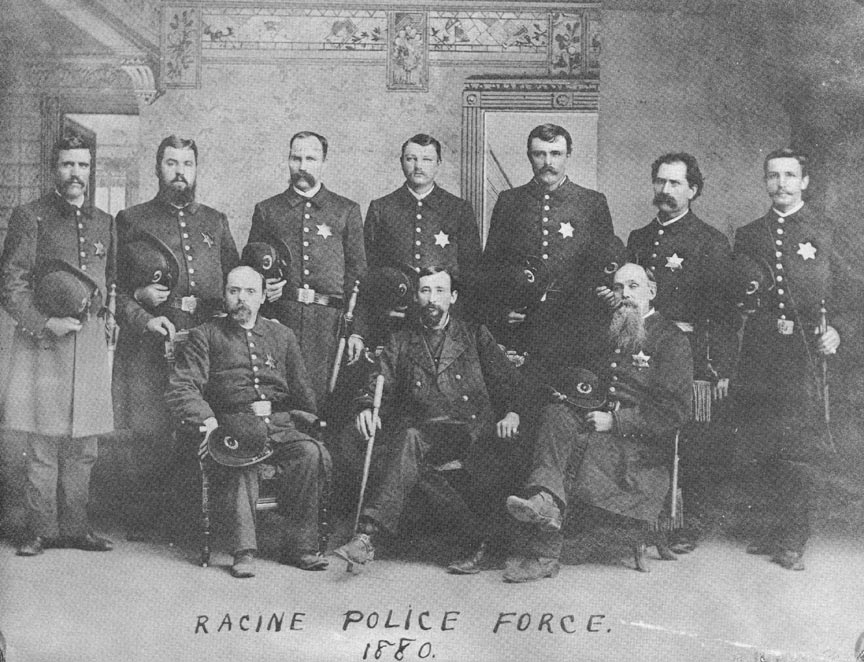
With the new developments in the field of technology work in the Industrial Age became more sedentary. Many workers were let of at 5, giving the citizens and early escape from the jail of a work day. This allowed more people to go home and enjoy leisure time. My father has always told me the more time I have on my hands, the more trouble I can get myself into. This was the case in this time of advancement and prosperity. Public disorder, drunkenness, and prostitution became popular offenses in this time period. The average number of arrests because of these offenses per officer was around 30 a year. Without the hard days of labor constantly shoved in the faces of the American citizens there was not much to do. Therefore mischief was a popular activity at the time.
 |
| A scene of Bootlegging. A common crime in the Industrial Age. |

distribution of alcohol in a city, it led to many other doors such as narcotics, prostitution, and
 |
| A replica of what a 1919 police car looked like. |

 |
| August Vollmer |
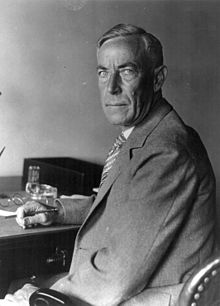
As the technology in the industrial age progres
sed, the use of machines not only helped the major tycoons, but also the police. Henry Faulds created the method of fingerprinting, which still to this day is a weapon of law and order(Policing in America). This machine allowed the policemen to now investigate crime scenes, and still have a chance of catching the criminal. Before this the only possible way for an arrest to be mad and justice to be served was if there was a witness present.
 |
| Secret Service in 1905 |
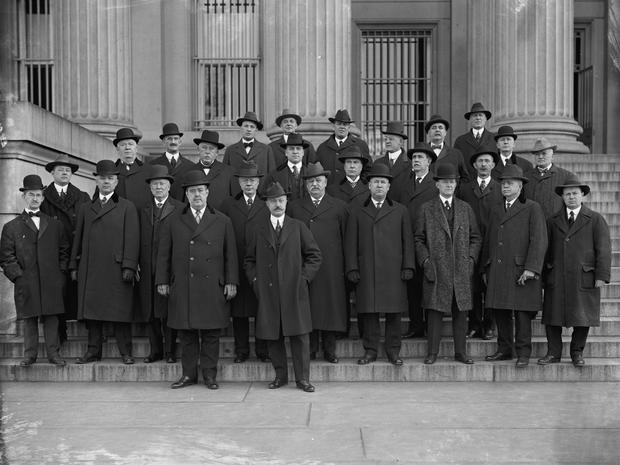
The Industrial Age came with many changes to the economy, cities, and social lives of the citizens with Untied States. As they changed, the police did too. It is human nature to find solutions and adapt to new environments. It is to no surprise that the men in blue changed with their society, as they continue to do today to help protect and serve the people of this country.
Citations:
Works Cited
This book was recommended to me by a fellow classmate. It contained specific facts on officers and their contributions towards police work.
T
Eriksen, Sverre, and Eval. "Police: History - Policing Twentieth-century Americaâ€." Officers, Citizens, Service, and Departments - JRank Articles. N.p., n.d. Web. 06 Feb. 2017.
This source gave me a more variety of facts on the vice squads, which became a popular topic in certain sections of my topic.
"Public Servants Photograph Collection, 1871-1939UALR.PH.0010." Public Servants Photograph Collection, 1871-1939UALR.PH.0010. N.p., n.d. Web. 06 Feb. 2017.
This primary source gave me photos of police officers in early time.
The Editors of Encyclopædia Britannica. "Bootlegging." Encyclopædia Britannica. Encyclopædia Britannica, Inc., 24 June 2009. Web. 06 Feb. 2017.
This source gave me a background on bootlegging, and facts that were helpful to support my claim of alcohol being a major offense.
"The History of Policing in the United States, Part 1." The History of Policing in the United States, Part 1 | Police Studies Online. N.p., n.d. Web. 06 Feb. 2017.
This was one of the first sources I looked at. It gave me a general idea of police work in the Industrial Age.
"The LAPD: 1900-1925." The LAPD: 1900-1925 - Los Angeles Police Department. N.p., n.d. Web. 06 Feb. 2017.
Subscribe to:
Posts (Atom)